Posts

Showing posts from November, 2023

Pattern Overload (And Why We Love It)

hprscript: Multi-Pattern Search Without Running grep N Times Why I built it Like many other programmers, I use AI agents for code development. A lot of the work is supervising what the agent does - reading its plans, checking its diffs, and sanity-checking the code it touches. That means a lot of grep commands, run one after another, often against the same tree. At some point I started thinking this was wasteful. Each grep invocation re-reads the files, re-compiles its pattern, and pays its own startup cost. And when an AI agent is the one driving, every separate search also re-sends the surrounding context to the model - the same conversation, the same instructions, the same tool schemas - just to ask one more question of the same codebase. Ten searches mean ten round trips, ten context replays, ten walks over the data. I knew there was a library that could match many patterns at once: Intel's Hyperscan . It compiles N regexes into a single DFA and matches them all ...
Innovation vs. Creativity (or Tactics vs. Strategy)

Nokia had the future in its drawer My first mobile phone was a Nokia. Around 2000 almost everyone's was: Nokia sold roughly a third of all handsets in the world, and at the height of the dot-com boom its market value briefly touched about €300 billion, making it the most valuable company in Europe. In 2013 Microsoft agreed to buy the entire phone business for €5.44 billion ( Silicon Canals ). How does the undisputed leader of an industry lose almost everything in a little over a decade? The usual explanation is that Nokia "missed the smartphone revolution". That is not quite true. Nokia sold its first smartphone, the Nokia 9000 Communicator, in 1996, and in 2010 it still held about a third of the smartphone market; by 2013 its share was under 3%. Nokia did not miss the smartphone. It missed a much bigger shift: a change in how a company and its community interact. Nokia understood too late that a smartphone is not a product but a platform, a place where a whole community ...

2025 - Global Demographic Transition

Image
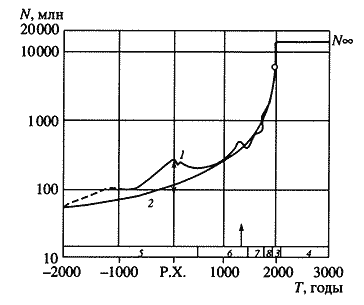
We stand at a pivotal moment in human history, not merely facing another crisis but confronting a fundamental shift in our existence. This is not a passing storm but a transformation that demands our attention and understanding. 2025 In my previous blog post " Globalization "  I delved into the demographic research of Russian professor Sergey Kapitsa, " PARADOXES OF GROWTH: LAWS OF GLOBAL DEVELOPMENT OF HUMANITY ".  Kapitsa identified a mathematical model that accurately represents global human population growth, expressed by the differential equation: \begin{equation} \large{}\color{blue}\frac{d N}{d T} = \frac{N^2}{2*10^{11}} \end{equation}Professor Kapitsa presented human population growth not only in form of differential eqation. He also introduced formal formula for calculating human population over time.\begin{equation} \large{}\color{blue}N = \frac{2*10^{11}}{2025-T} \end{equation}where N is number of people over globe and T is year. In picture you can s...

Globalization

Image
In my previous post, " Life, Death, and 'The Winner Takes It All' " I discussed a simple differential equation that can be used to calculate population size \begin{equation} \large{}\color{blue}\frac{d x}{d t} = x \end{equation} This equation, known as the exponential function, becomes more complex when it incorporates death rates (the logistic function) and competition (the "struggle of information" model). However, the underlying principle of these models remains the same: the growth rate of a population is proportional to its current size. This principle holds true for most species, but there is one notable exception: humans. Humans are unique in that their population growth does not follow the basic principle outlined above. The study of human population size and growth rates is known as demography. Demographers collect statistics on the number of people in different areas and develop mathematical models to represent these numbers as accura...